|
|

Civic Service House: 112 Salem St.
Civic Service House, one of several settlement houses in Boston, was founded
in 1901 to provide services for local residents and newly-arrived immigrants.
In 1905, Frank Parsons, a nationally known social and political reformer,
founded the Breadwinners’ College here to provide educational opportunities
for members. He then founded the Vocational Guidance Bureau here in 1908,
offering organized vocational guidance and counseling services to young
adults. Parson’s initiative was the first systematic process for providing
vocational guidance and counseling; it laid the cornerstone for the American
counseling movement.
Molasses Flood: Commercial St. near Copp’s Hill
On January 15, 1919, a molasses tank at 529 Commercial Street exploded
under pressure, killing 21 people. A 40-foot wave of molasses buckled
the elevated railroad tracks, crushed buildings and inundated the neighborhood.
Structural defects in the tank combined with unseasonably warm temperatures
contributed to the disaster.
Second Church Site: 2 North Square
The Second Church, also called the "Old North Meeting House,"
was established in 1650 by the Puritans when the First Church in the center
of Boston could no longer accommodate the colony’s growing population.
It was known as the "Church of the Mathers" because both Increase
and Cotton Mather preached there. The first building burned in 1673; it
was rebuilt the following year and was one of North Square’s most important
landmarks until the British used it for firewood in the winter of 1775-76.
After the Revolution, the congregation joined the nearby "New Brick
Church" on Hanover Street.
As of August 11, 2000.
* Indicates Designated Boston Landmark
The Bostonian Society © 2003
Nothing from the site may be reproduced without specific written permission
issued by: The Bostonian Society I 206 Washington Street I
Boston, MA 02109 – 1773
Any questions, call (617) 720 1713
|
 |
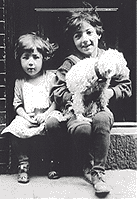
Two Children and their Dog
Two children from the North End find their dog to be a playful companion
(ca. 1910).
|


